
Welcome to Differentiation Part I: What is it? What isn’t it? This episode addressed a more philosophical approach to differentiated instruction in the regular education classroom, and the next episode will address more practical approaches and strategies.
Let’s start here. If you’re reading along with me, do me a favor. Read this definition of differentiation (adapted from here and here) and then pause. What stands out to you? What do we do well? What’s more difficult to implement?
Differentiation begins with high-quality curriculum and instruction and is guided by general principles such as respectful tasks, flexible grouping, and ongoing assessment and adjustment.
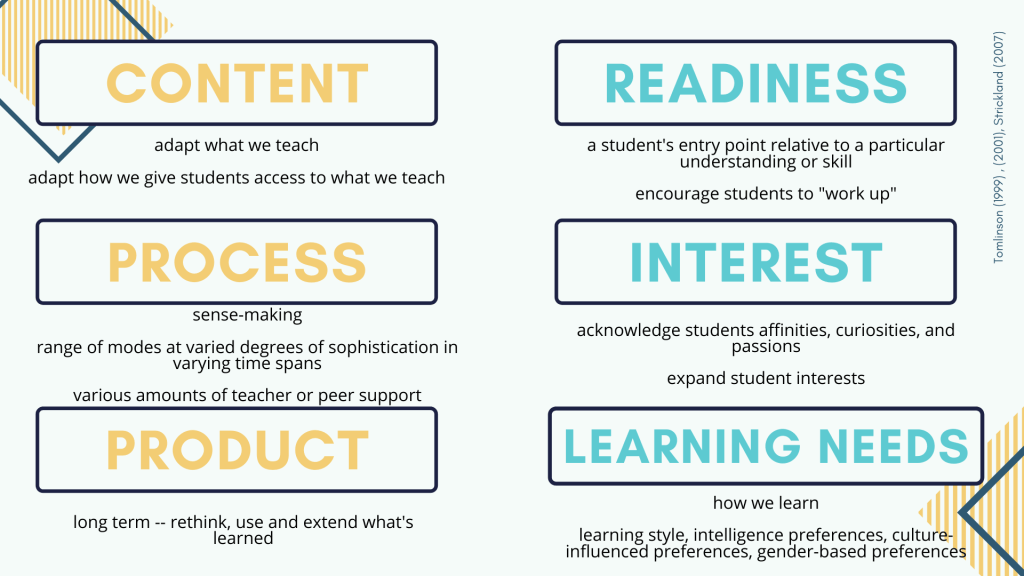
The teacher proactively plans and carries out various approaches to content, process, and product in anticipation of and response to student differences in readiness, interest, and learning needs.
There’s a lot to unpack here, for sure. And a lot of moving pieces. To keep it straight in my head, I try to picture the movement from Stage One through Stage Three of UbD. And in figuring out how I need to differentiate in my learning plan, I picture this Matrix (adapted from here):
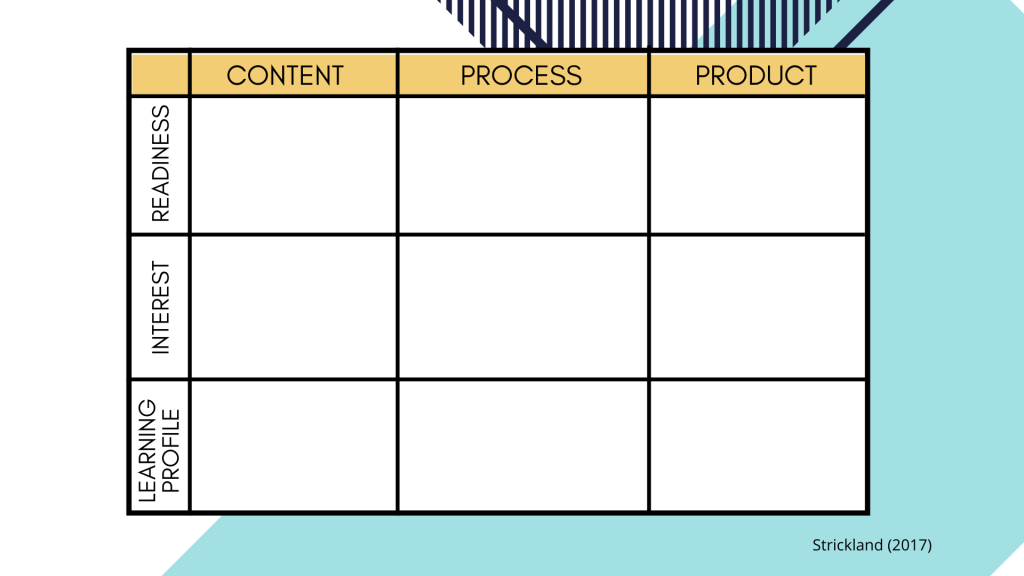
Or this one (picture matching the left side with the right with various lines):
Differentiation: The Misconceptions
Here’s another way of looking at it:
| DIFFERENTIATION IS | DIFFERENTIATION IS NOT |
|---|---|
| Providing multiple approaches to content, process and product. | Individualized education that assumes a separate level for each learner |
| Student-centered | Teacher-centered |
| Blend of whole-class, group, and individual instruction | Chaotic |
| Proactive | Modification of standards/outcomes |
| Qualitative | Quantitative (assigning more or less) |
| Rooted in assessment | Another way to provide homogeneous grouping |
| Over-emphasis on one instructional strategy |
Now that we have differentiation in theory, please join us for our next installment, Differentiation, Part II, where we discuss specific strategies to implement in order to address the diverse needs of our students.

